Intermediate Interface Layer
The intermediate interface layer adapts the KubeEdge cluster to Dayu's runtime deployment and communication model. The current system uses the matched dayu-sedna v1.1 and dayu-edgemesh v1.1 releases.
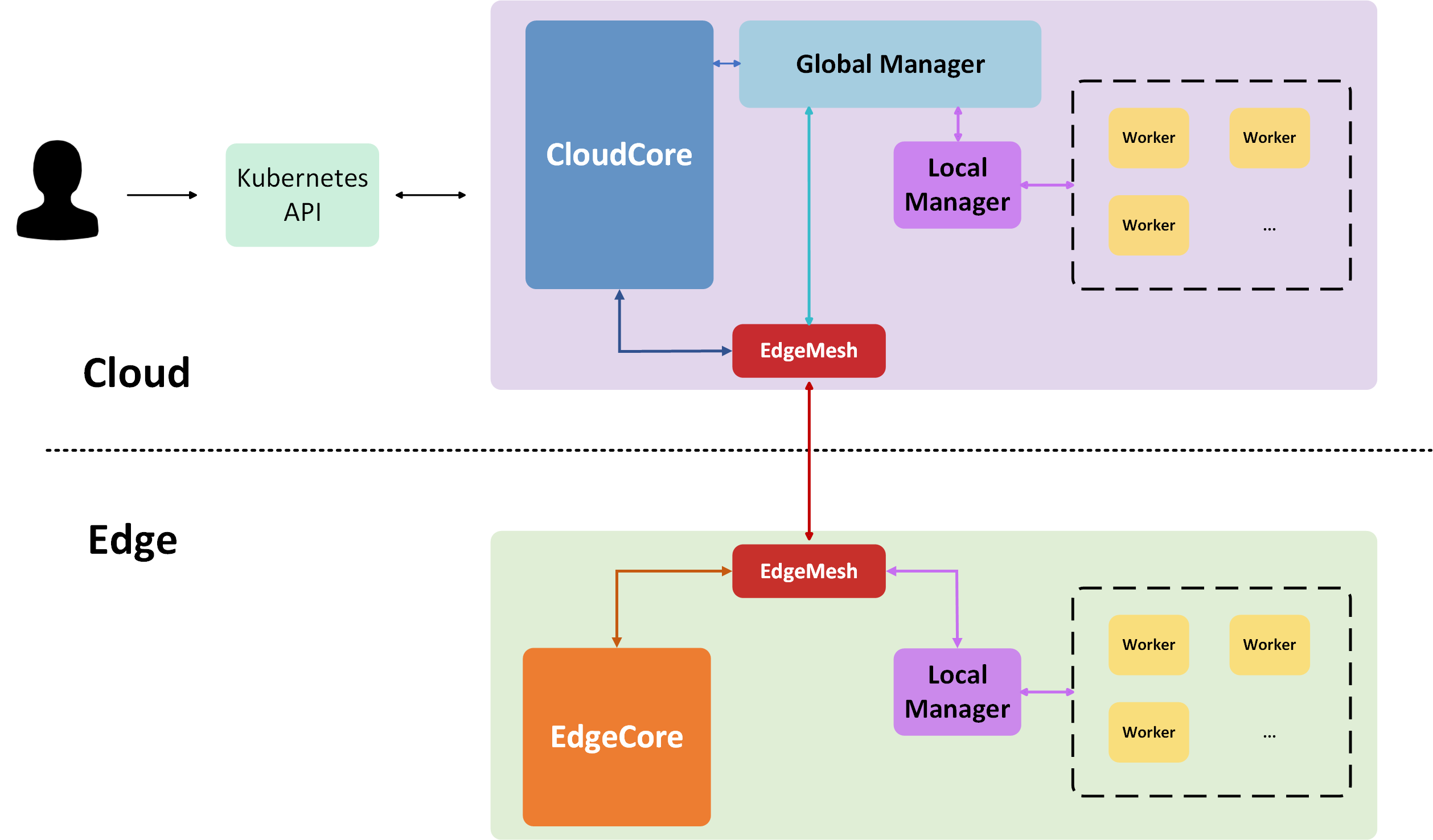
Sedna runtime services
dayu.sh uses the configured Sedna support CRD to start the long-lived platform services. Application runtime workers
are different: Backend renders Scheduler, Generator, Controller, Processor, Distributor, and Monitor instances as
immutable sedna.io/v1alpha1 RuntimeService resources.
Sedna Global Manager and Local Controller coordinate each runtime revision. Backend does not publish a worker until
Sedna reports the expected specification and exact RuntimeService, Service, and Pod identities with both
Activated=True and Ready=True. This prevents a running but unroutable Pod from entering the active runtime.
EdgeMesh routing
EdgeMesh provides service communication across cloud and edge nodes. The Dayu integration acknowledges the exact
Service and Pod identity created for a RuntimeService, rather than treating workload creation alone as readiness.
Scheduler records the acknowledged endpoints in a versioned RuntimeDirectory, and runtime tasks carry only those
exact routes.
Runtime workers do not list Kubernetes objects, refresh a topology cache, or choose a replacement route. Kubernetes access belongs to Backend; route authority belongs to Scheduler. Missing or stale route identity is therefore reported as an error instead of silently falling back to another replica.