Spatiotemporal imbalance
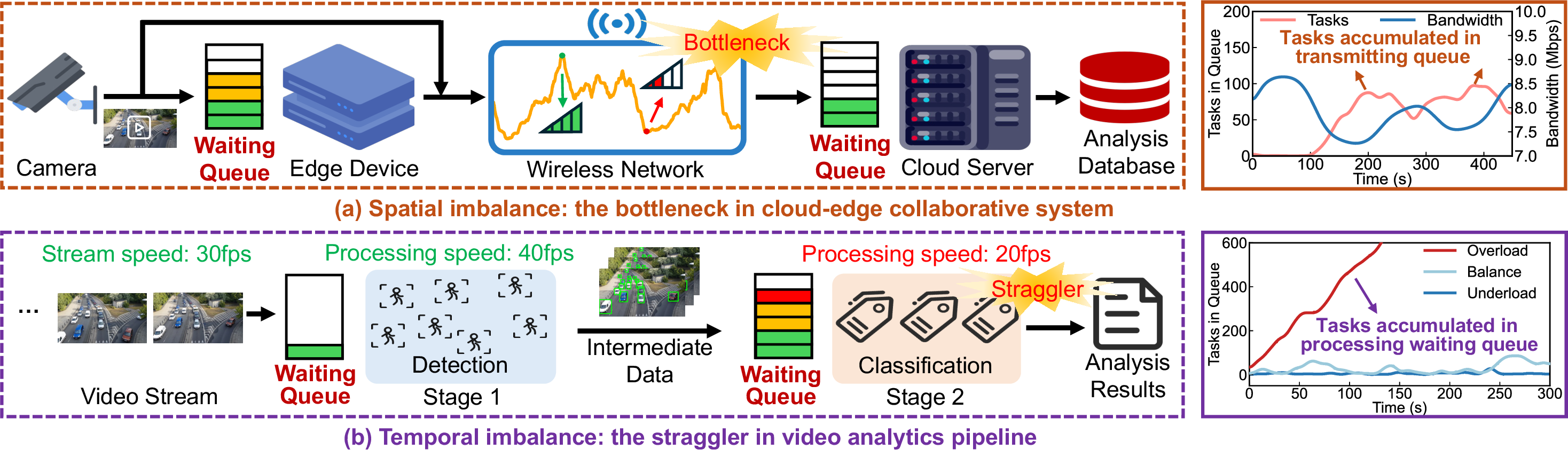
Models spatial cloud-edge bottlenecks and temporal pipeline stragglers as a unified scheduling challenge.
Models spatial cloud-edge bottlenecks and temporal pipeline stragglers as a unified scheduling challenge.
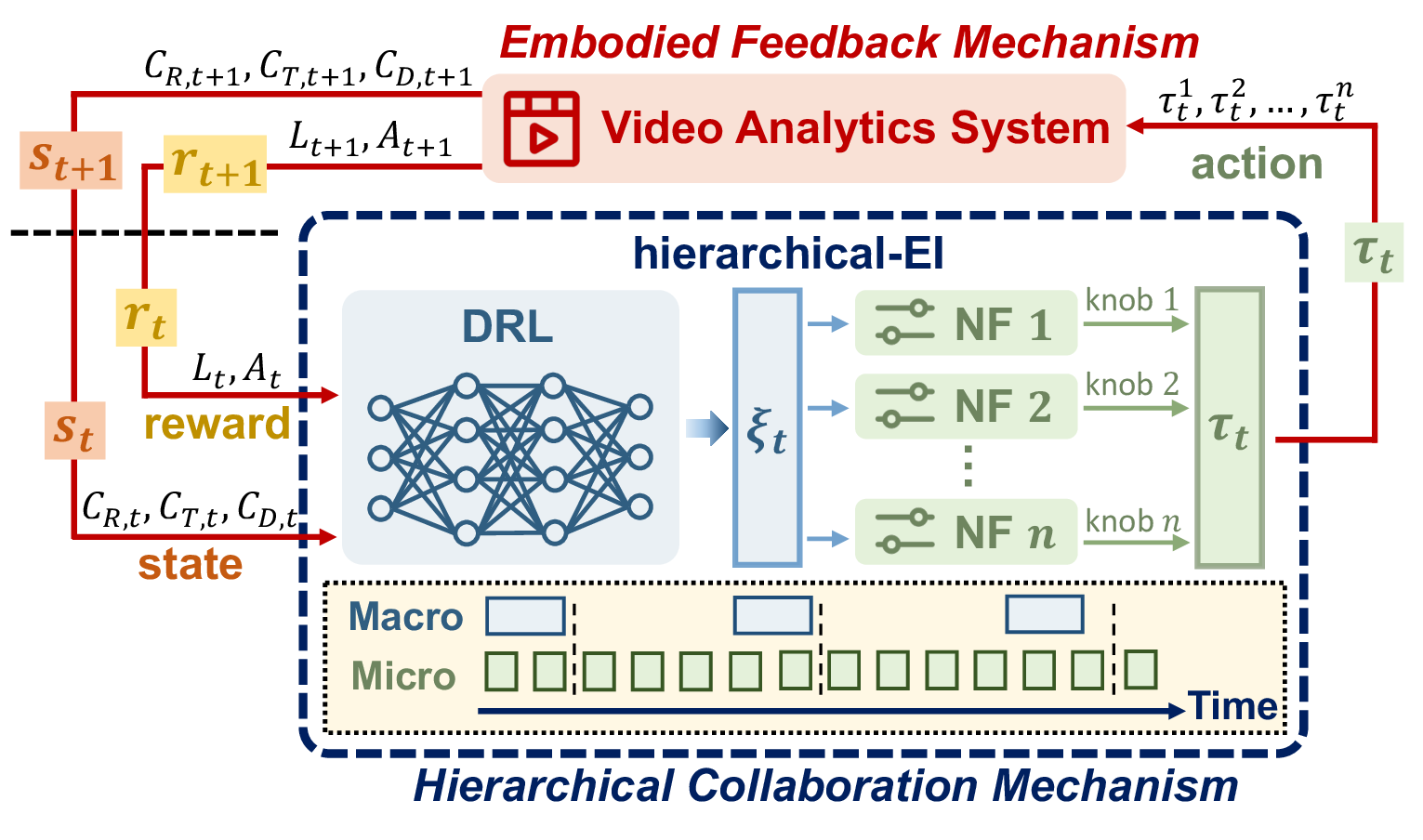
Reduces the multi-knob search space from million-level combinations to tractable hierarchical actions.
Continuously perceives resource/task context and updates policies through measured QoE feedback.
With the proliferation of heterogeneous software-hardware infrastructures in camera deployment, video analytics pipelines (VAPs) are increasingly burdened by spatiotemporal workload imbalance, where uneven task distributions lead to latency constraint violations and degraded quality of experience (QoE). Eliminating this imbalance is challenging due to the inherent complexity of adjusting large-scale parameters and the dynamic nature of VAP runtime environments.
We propose Hier-EI, a scheduling framework that combines a two-phase hierarchical design with embodied intelligence. It decomposes million-level combinatorial knob decisions into a linear coarse-to-fine workflow and uses closed-loop feedback to adapt to runtime dynamics. On a KubeEdge-based prototype, Hier-EI achieves a 3.6x improvement in latency compliance and a 67.4% reduction in P95 latency compared with state-of-the-art scheduling methods.
Cloud-edge VAPs suffer from two coupled sources of imbalance. Spatial imbalance arises when wireless bandwidth and heterogeneous edge/cloud hardware create transmission bottlenecks. Temporal imbalance arises when adjacent pipeline stages process tasks at different rates, causing stragglers and queue buildup.
Existing profiling, end-to-end learning, and single-knob feedback methods struggle when the system must jointly adjust frame resolution, frame rate, buffer size, pipeline partitioning, and region allocation under continuously changing resource and task contexts.
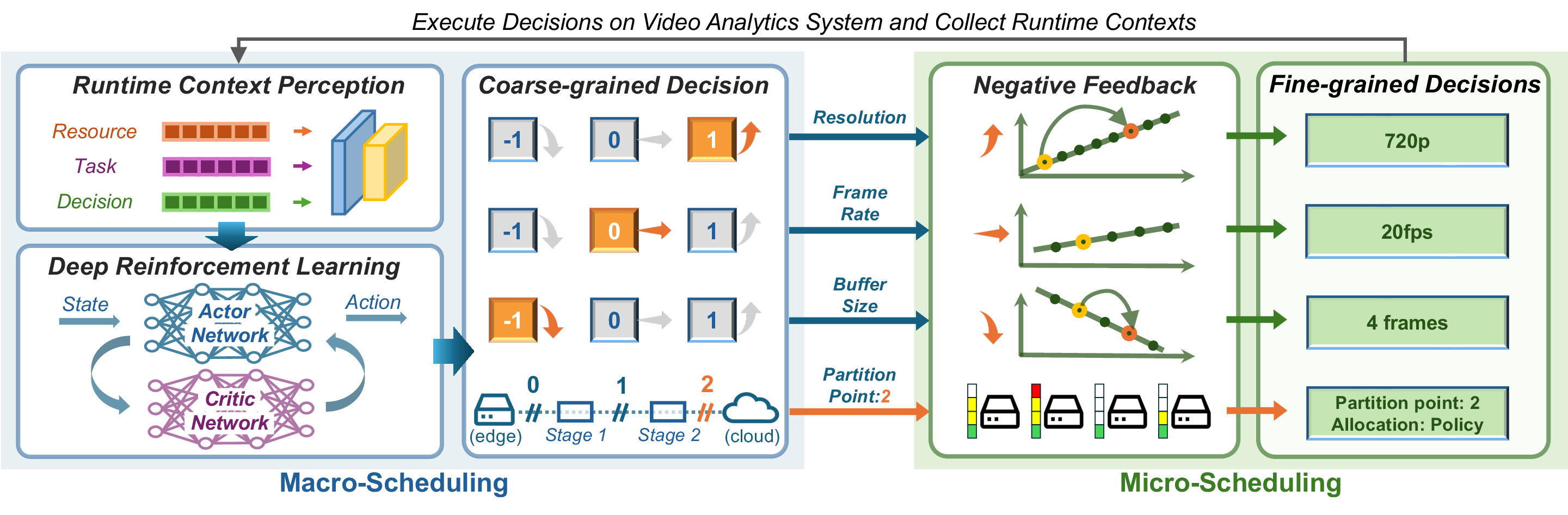
A Soft Actor-Critic agent perceives bandwidth, task features, historical delay, and previous decisions, then emits coarse directions such as decrease, keep, or increase.
Negative-feedback controllers transform macro directions into fine-grained knob values for resolution, frame rate, buffer size, and pipeline partitioning.
Hier-EI treats the scheduler and VAP as a closed-loop MDP: decisions change system state, measured runtime context updates rewards, and the next policy adapts.
Macro scheduling runs at a longer interval for global coordination, while micro scheduling reacts faster to sudden imbalance without waiting for every DRL update.
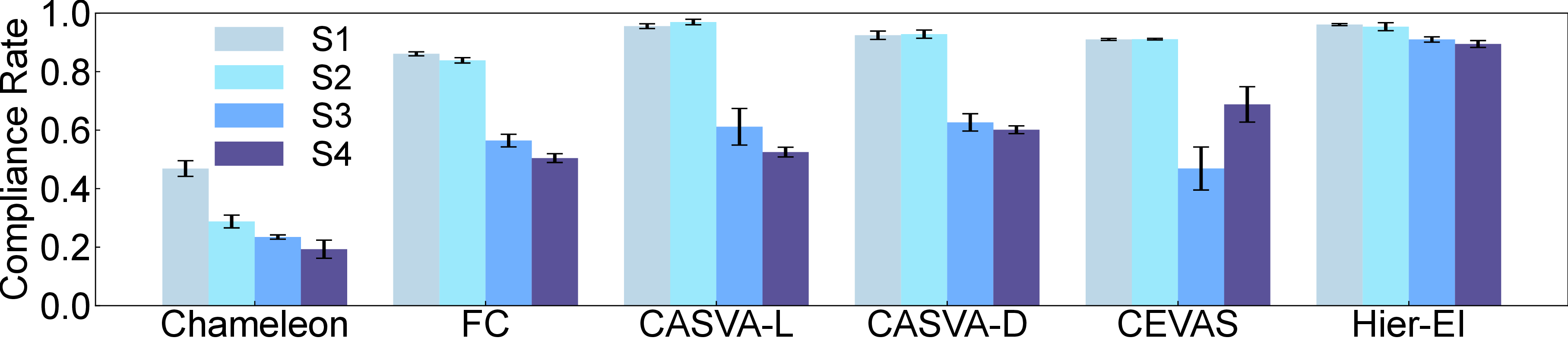
Applications. Road surveillance over UA-DETRAC videos and pedestrian monitoring over YouTube videos.
Scenarios. Four settings combine stable/unstable networks and sparse/dense object workloads.
Baselines. Chameleon, FC, CASVA-L, CASVA-D, and CEVAS.
Extreme case. In S4, Hier-EI improves latency compliance by 358.42% and reduces P95 latency by 67.43%.
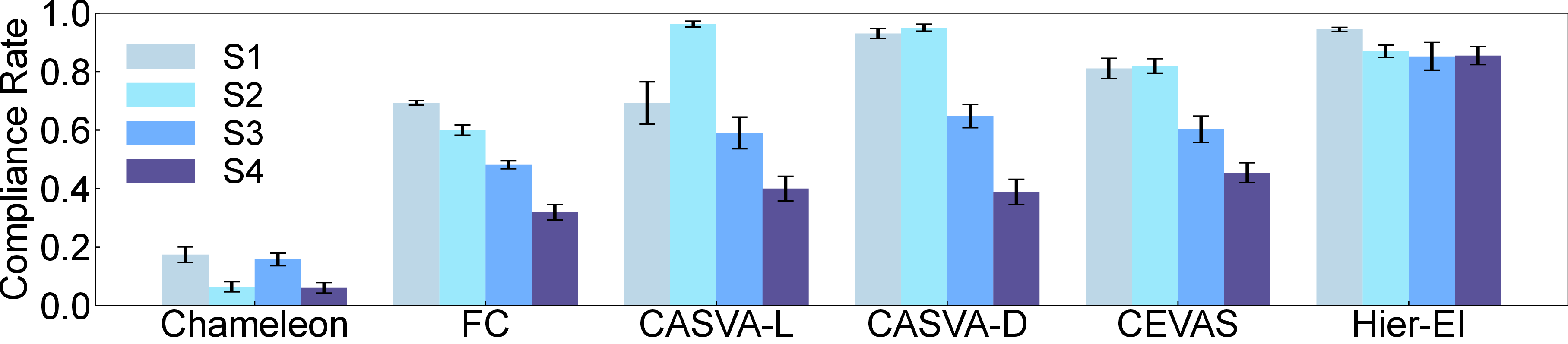
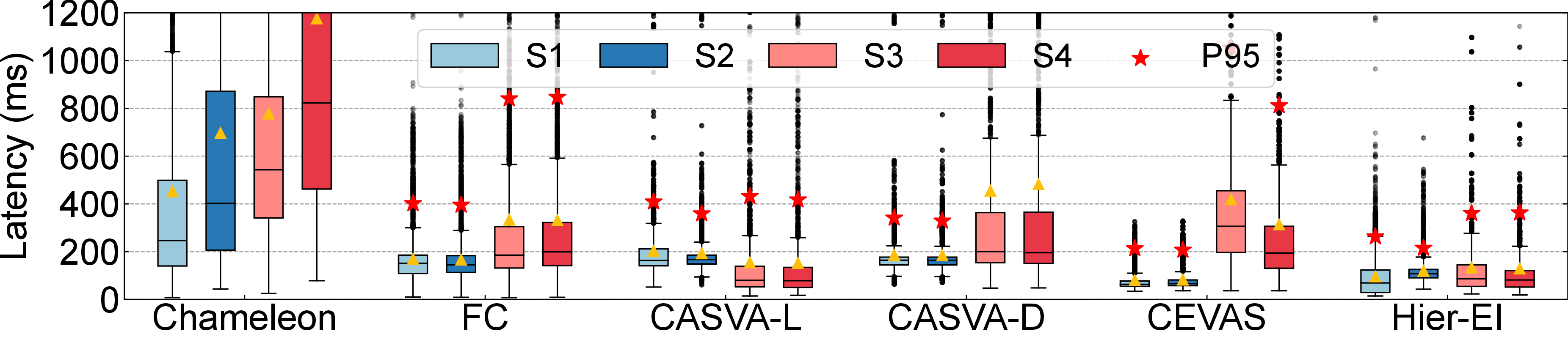
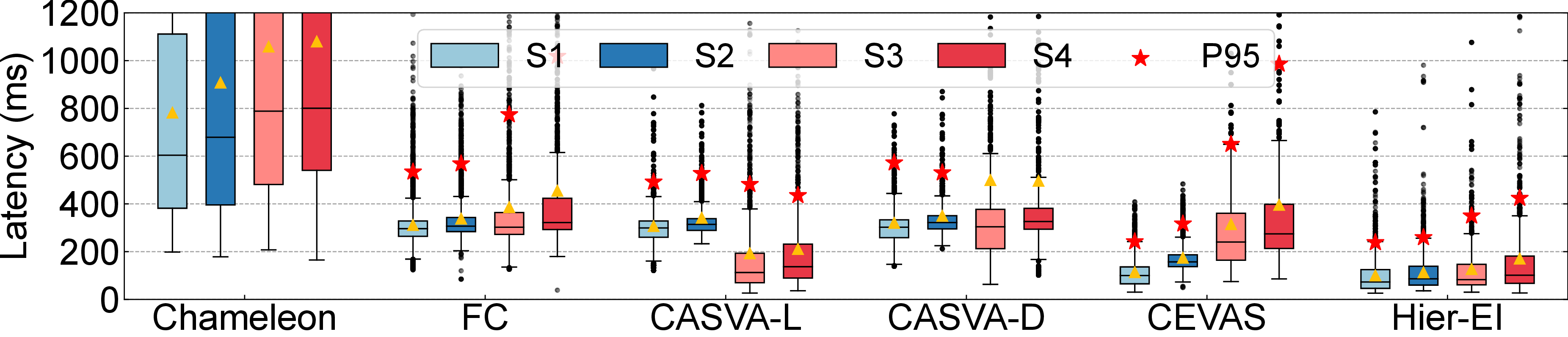
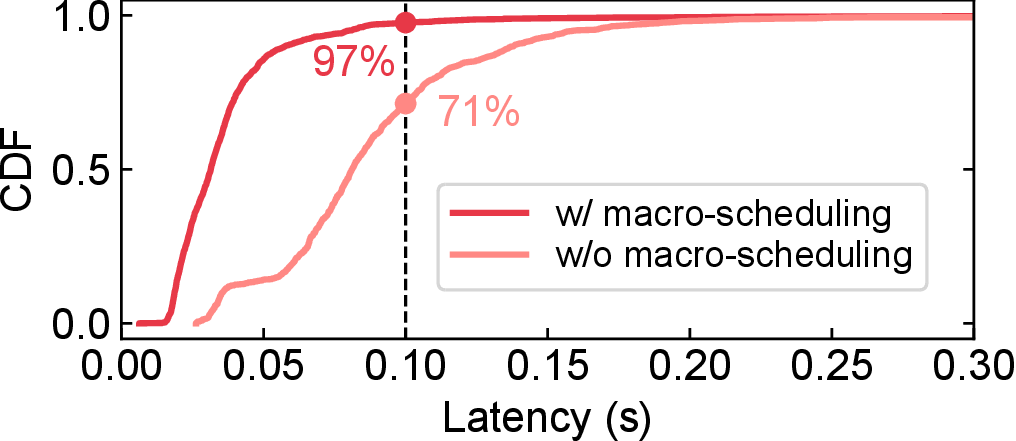
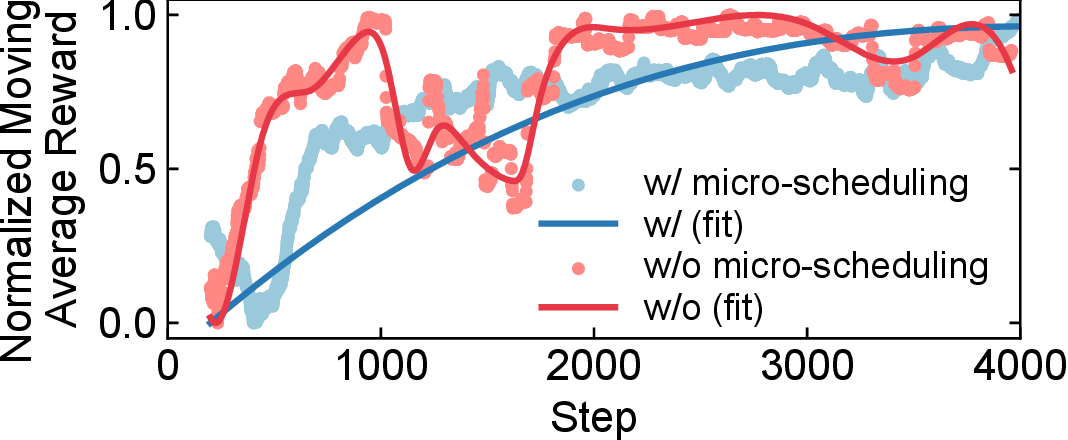
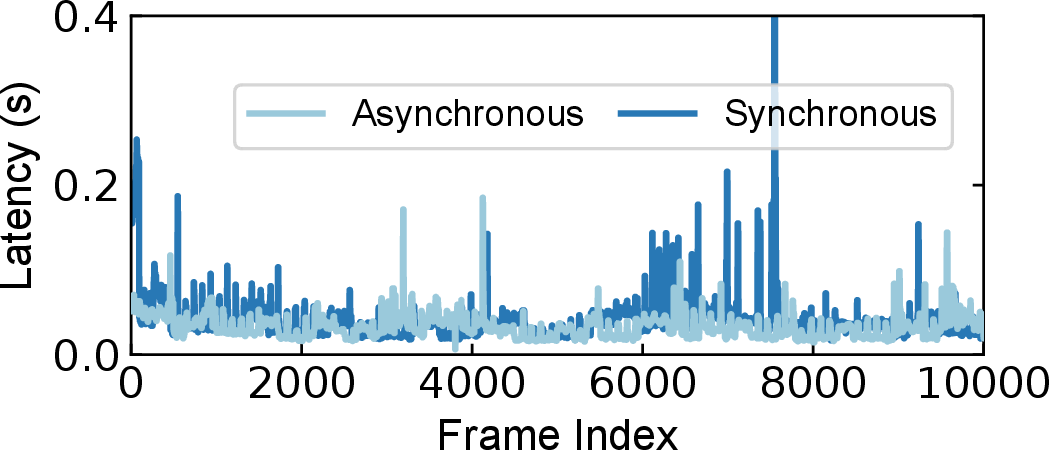
Hier-EI is implemented as a scheduler policy inside Dayu. The code path mirrors the paper: a policy YAML selects the HEI agent, the agent runs macro DRL and micro negative feedback, and the scheduler exports updated video-configuration and offloading decisions.
SCH_AGENT_NAME=heitemplate/scheduler/hei.yaml
Declares the HEI scheduler configuration, model directory, mode, and mounted runtime files.
Agent Orchestrationschedule_agent/hei_agent.py
Runs SAC macro scheduling and negative-feedback micro scheduling with asynchronous intervals.
Macro DRLschedule_agent/hei/drl/
Implements the Soft Actor-Critic model, replay buffer, adapters, and neural networks.
Micro Feedbackschedule_agent/hei/nf/negative_feedback.py
Maps coarse directions to fine-grained resolution, FPS, buffer-size, and partition decisions.
@inproceedings{zhou2026hier-ei,
  title = {Tackling the Imbalance in Video Analytics Pipelines with Hierarchical Embodied Intelligence},
  author = {Zhou, Wenhui and Xie, Lei and Ning, Jingyi and Cao, Shuyu and Wu, Hao and Peng, Qinghua and Fan, Long},
  booktitle = {IEEE INFOCOM 2026 - IEEE Conference on Computer Communications},
  year = {2026},
  pages={1--10},
  publisher = {IEEE},
  doi={10.1109/INFOCOM59046.2026.11571610}
}